Eseandre Mordi
The XRP Ledger is moving into a more programmable phase with the arrival of XLS-100 Smart Escrows, a protocol change that allows developers to create custom release conditions directly on-chain. As Xaif Crypto noted, the key shift is simple but important: escrow on XRPL is no longer limited to basic time locks, with WebAssembly now powering more flexible execution logic inside the network.
A New XRPL Step Beyond Basic Escrow
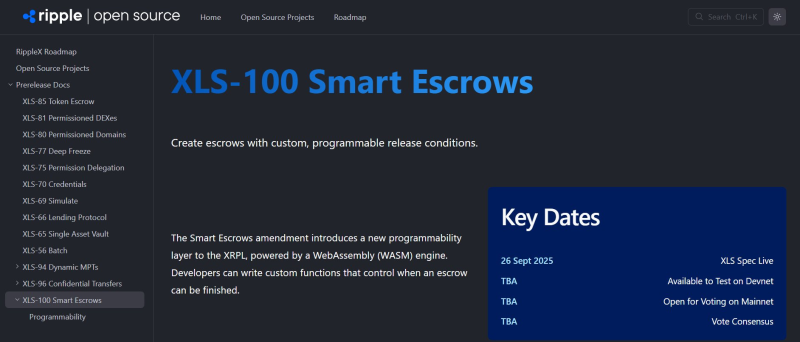
The core change is this: developers can now define custom conditions for releasing funds on XRPL, rather than relying only on standard lockup mechanics. The XLS-100 amendment adds a new programmability layer to the ledger powered by a WebAssembly engine, with the XLS spec listed as live as of September 26, 2025, while devnet testing and voting milestones remain TBA.
Escrow on XRPL is no longer limited to basic time locks - WebAssembly now powers more flexible execution logic, turning a static feature into a more adaptable one.
That makes this a protocol-development update rather than a market-structure signal - but the architectural implications are meaningful for anyone building on the ledger.
XRPL's Upgrade Path Is Getting More Specialized
What stands out here is not just the escrow feature itself, but the direction of travel for the network. Recent XRPL coverage has increasingly focused on utility expansion, institutional use cases, and protocol-level upgrades rather than pure price speculation.
XRP Ledger Gains Traction as Firms Tokenize $372M in Private Credit shows how the ledger is already being used for real institutional settlement - the kind of use case that programmable escrow logic is designed to support at a deeper level. XRPL News: XRP Ledger Gets World Economic Forum Nod for Debt Tokenization adds further context, showing how XRPL's infrastructure credibility is being recognized at an institutional level well beyond the crypto-native audience.
Why the XLS-100 XRPL Update Matters for XRP
Making escrow programmable turns one of XRPL's native building blocks into a more adaptable tool - one that could eventually support more advanced payment logic, conditional settlements, and complex financial instruments directly on-chain.
Network utility often becomes part of the long-term XRP story - and protocol changes that expand what can actually be done on the ledger tend to matter more than short-term noise.
XRPL News: Security Revolution - New Firewall Could Change Everything shows that XLS-100 is not an isolated upgrade - XRPL has been consistently advancing its protocol stack across security, programmability, and institutional readiness simultaneously.
The real takeaway from XLS-100 is less about hype and more about architecture: XRPL is giving escrow logic a programmable upgrade, and for traders and builders watching the network, that is the kind of development that compounds over time as the ledger becomes capable of handling more sophisticated on-chain logic.
 Eseandre Mordi