Peter Smith

⬤ Amazon just crossed a major automation milestone, hitting one million robots working across its operations. This puts the company's robot-to-human ratio at about 1:1.5, with roughly 1.5 million employees still on the payroll. It's one of the most dramatic examples of robotics integration at any company worldwide. The shift has been building for over a decade, fundamentally changing how Amazon runs its warehouses and fulfillment centers.
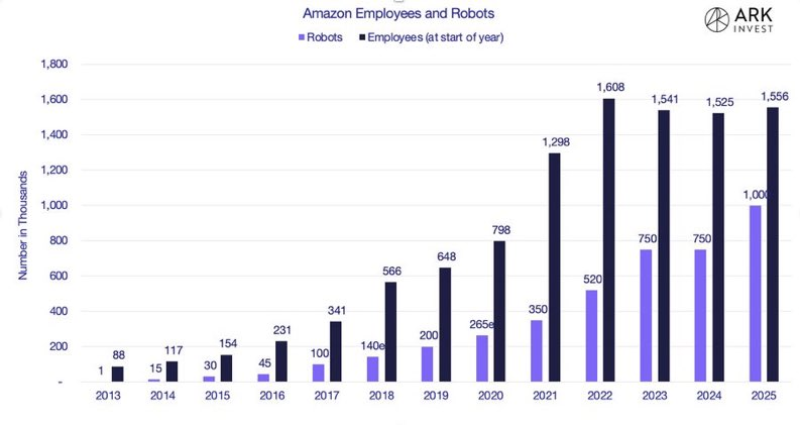
⬤ The numbers tell the story clearly. Back in 2013, Amazon had just 1,000 robots and 88,000 employees. Fast forward to 2025, and those figures have exploded to 1,000,000 robots and about 1,556,000 workers. The robot count has grown much faster than headcount, showing how quickly automation has taken over repetitive warehouse tasks. This shift is expected to help Amazon improve its profit margins as machines handle more of the heavy lifting in logistics and fulfillment.
⬤ There's also talk that Amazon might start licensing its robotics technology to other companies, creating a whole new revenue stream. With robots being added at a consistent pace year after year, Amazon has built serious expertise in warehouse automation. The company is proving you can scale both human workers and robots at the same time to keep up with growing demand. This dual approach could open doors beyond just running its own operations more efficiently.
⬤ Amazon's robot rollout is reshaping everything from cost structure to competitive advantage. As the robot fleet approaches the size of the human workforce, questions about productivity, flexibility and how labor gets distributed become more important. The long-term trend shows automation isn't just a side project anymore—it's core to how Amazon operates and signals bigger changes coming to global retail and logistics.
 Peter Smith